
P0137 Code: O2 Sensor Circuit Low Voltage
Bank 1, Sensor 2 – Causes, Symptoms & Fix
P0137 means the downstream oxygen sensor on Bank 1 (Sensor 2) is reading abnormally low voltage — below 0.4V for 20+ seconds. The most common fix is replacing the downstream O2 sensor ($50–$150 DIY) or repairing a damaged wiring connector. You can drive short distances, but prolonged driving risks catalytic converter damage worth $500–$1,500. Always use live data to confirm the root cause before replacing any parts.
| Definition | O2 Sensor Circuit Low Voltage — Bank 1, Sensor 2 |
|---|---|
| Severity | Moderate–High — MIL on, emissions failure, converter risk |
| Trigger | Sensor voltage < 0.4V for 20+ seconds |
| Location | After catalytic converter, Bank 1 (cylinder #1 side) |
| Common Vehicles | Toyota, Honda, Ford, Chevrolet, Vauxhall/Opel |
| Related Codes | P0136, P0138, P0141, P0420, P0157 |
| DIY Fix Cost | $50–$150 (O2 sensor only) |
| Pro Fix Cost | $150–$600 sensor; $500–$1,500 converter |
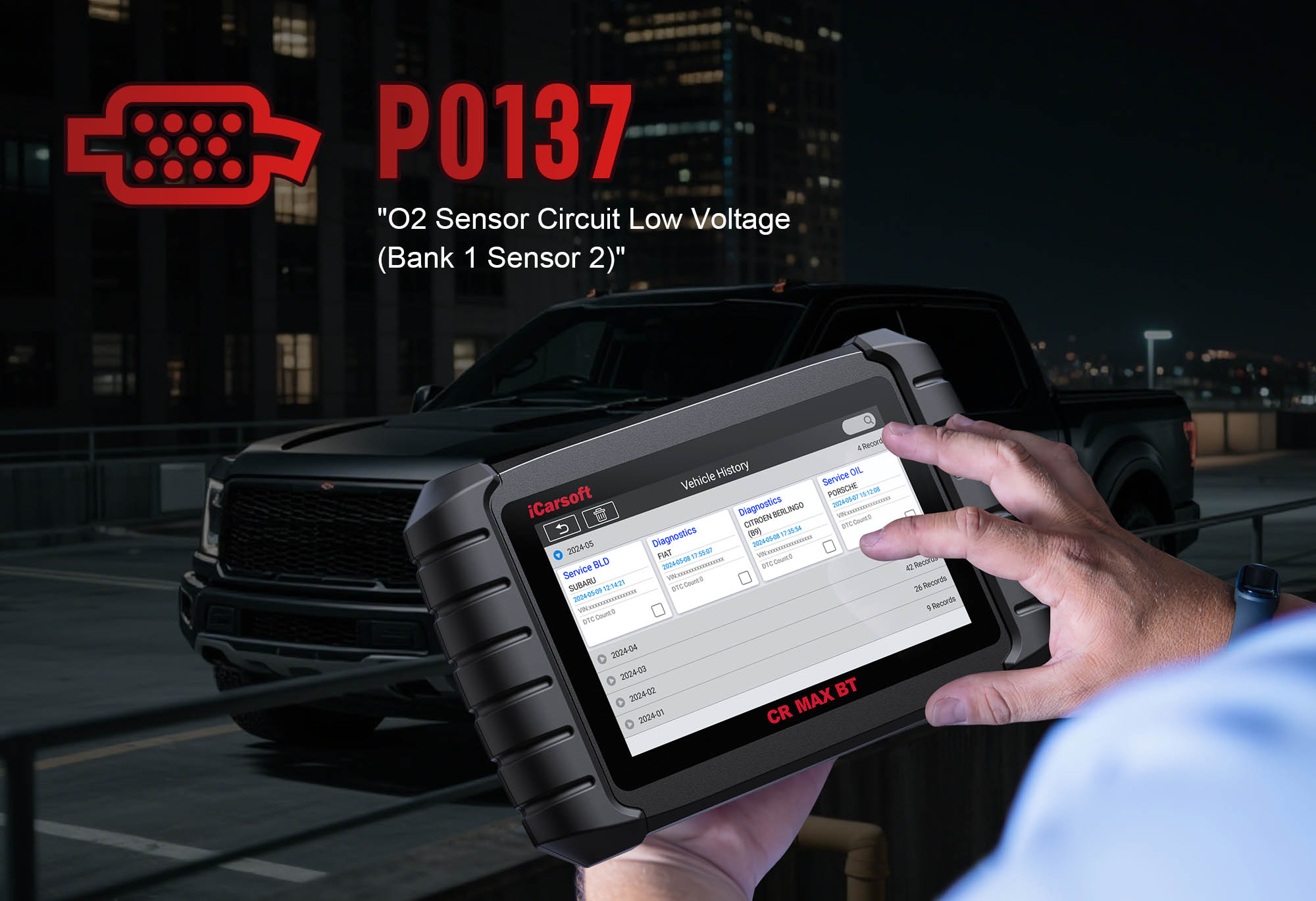
| Recommended Tool | iCarsoft CR MAX BT |
Bank 1 Sensor 2 is located downstream — after the catalytic converter on the cylinder #1 side.
What Does P0137 Mean?
When your Check Engine Light turns on and a scan shows P0137, the PCM has detected that the downstream oxygen sensor on Bank 1 (Sensor 2) is producing unusually low voltage — specifically below 0.4V for 20+ consecutive seconds.
Symptoms of P0137
P0137 may not cause obvious drivability issues immediately, but these signs commonly appear:
Need to read live O2 sensor voltage?
The iCarsoft CR MAX BT streams real-time Bank 1 Sensor 2 voltage to your phone — the fastest way to confirm P0137 before buying any parts.
What Causes P0137?
Five primary causes, ordered by frequency — work through them in sequence before replacing any parts:
Faulty Downstream O2 Sensor — Most Common
Internal failure of the sensor's ceramic element or heater circuit. High-mileage sensors (100K+ miles) are especially prone. Accounts for ~60–70% of P0137 cases.
Wiring or Connector Damage
Corroded terminals, frayed wires, or a loose connector create resistance that reduces the voltage signal reaching the PCM. Common on vehicles exposed to road salt, heat, or vibration.
Exhaust Leak Upstream of Sensor 2
A leak draws in fresh air, diluting exhaust gases and causing artificially low voltage — even if the sensor itself is perfectly functional.
Failing Catalytic Converter
A degraded converter alters exhaust gas composition at Sensor 2, producing low or erratic voltage. Often paired with P0420 — if both appear, suspect the converter first.
PCM Issue — Rare
A PCM software glitch occasionally misreads sensor voltage. Only investigate after all hardware causes are definitively eliminated.
Quick Diagnosis Decision Path — What codes do you see?
How to Diagnose P0137 — Step by Step
Systematic diagnosis saves money. Follow these steps in order before purchasing any replacement parts:
Connect your scanner to the OBD-II port. Confirm P0137 is active or pending, and record companion codes (P0136, P0420, P0141). Review freeze-frame data — it captures engine speed, load, coolant temp, and fuel trim at the exact moment the fault triggered.
With the engine fully warmed up (10+ minutes), navigate to: Live Data → O2 Sensors → Bank 1 / Sensor 2 → Voltage. A healthy downstream sensor holds stable voltage between 0.4–0.6V. Below 0.4V consistently confirms the fault is active.
Locate the downstream sensor and inspect carefully for: green corrosion on terminals → clean with electrical contact cleaner; cracked insulation near heat sources → replace harness; loose connector pins → re-seat or crimp. A wiring fault can perfectly mimic a failed sensor.
Inspect manifold gaskets, flex pipes, and converter inlet seams upstream of Sensor 2. A small exhaust leak drawing in fresh air produces identical low-voltage readings to a failed sensor. Listen for ticking or hissing on a cold start that fades as the exhaust warms up.
Remove the cooled downstream sensor and test heater circuit resistance. Typical spec: 6–20 ohms between heater pins — verify against your vehicle's OEM service data. An open circuit or out-of-range reading confirms sensor failure.
After repair, clear all codes. Complete a full OBD-II readiness drive cycle: cold start idle → city stop-and-go → 10+ min highway cruise → deceleration without braking. Re-scan after 50–100 miles. If P0137 does not return and all monitors show "Ready," the repair is confirmed.
Understanding Sensor Voltage — Live Data Guide
What different voltage readings from Bank 1 Sensor 2 mean during diagnosis:
Bank 1 Sensor 2 — Voltage Interpretation
* Verify against OEM service data for your specific vehicle.
How to Fix P0137
Option 1: Replace the Downstream O2 Sensor (Most Common)
Allow exhaust to cool 30+ minutes. Apply penetrating oil to threads 10–15 min before removal. Use an O2 sensor socket (slotted for the wire). Torque to OEM spec (typically 27–44 Nm). Use an OEM-spec or quality aftermarket sensor matched to your exact make, model, and year.
Option 2: Repair or Replace Wiring / Connector
Clean corroded terminals with electrical contact cleaner and re-crimp. A $10–$30 fix that resolves many P0137 cases. Replace damaged harness sections as needed.
Option 3: Seal Exhaust Leaks
Small leaks can be sealed with high-temperature exhaust sealant ($10–$15). Cracked flex pipes or blown gaskets require component replacement. Always address exhaust leaks before replacing the O2 sensor.
Option 4: Replace the Catalytic Converter
Only when confirmed degraded via backpressure testing or live data. Replace with a compliant unit. Never attempt to bypass the converter — illegal and will set additional codes.
Option 5: PCM Reprogramming (Last Resort)
Only after all hardware causes are definitively eliminated. A PCM reflash at a dealer resolves software-related misreadings.
Repair Cost Breakdown
| Repair | DIY Cost | Professional Cost | Time |
|---|---|---|---|
| O2 Sensor Replacement — Most Common | $50–$150 | $150–$600 | 30–90 min |
| Wiring / Connector Repair | $10–$30 | $100–$300 | 30–60 min |
| Exhaust Leak Repair | $5–$40 | $100–$400 | 1–3 hrs |
| Catalytic Converter | $150–$600 | $500–$1,500 | 2–4 hrs |
| PCM Reprogram | Not recommended | $100–$400 | 1–2 hrs |
Diagnose P0137 Yourself with iCarsoft CR MAX BT
You need more than a basic code reader. The CR MAX BT gives you everything to confirm the root cause before spending on parts:
- 7-inch HD touchscreen for clear live data monitoring
- Real-time Bank 1 Sensor 2 voltage streaming
- Bluetooth wireless — monitor during test drives
- Freeze-frame capture for intermittent faults
- STFT/LTFT fuel trim data for exhaust leak diagnosis
- Code clearing + readiness monitor verification
P0137 on Common Vehicle Makes
While P0137 can appear on any OBD-II gasoline vehicle, certain makes have known patterns:
Toyota / Lexus Very Common
- Frequent on Camry, Corolla, RAV4 (150K+ miles)
- Primary cause: ceramic element aging — not wiring
- Use Denso or NGK OEM sensors — cheap aftermarket sensors cause re-triggers within weeks
Honda / Acura Very Common
- Common on Accord, Civic, CR-V, Odyssey
- Check connector behind heat shield first — the #1 corrosion point on Honda exhaust layouts
- P0141 (heater circuit) often pairs with P0137
Ford / Chevrolet Common
- Reported on F-150, Explorer, Fusion, Silverado, Malibu
- Check exhaust manifold cracks and flex pipe for cracks
- OEM or Bosch sensors recommended
Vauxhall / Opel Common
- Frequent on Astra, Corsa, Insignia
- In salt-road regions: connector seal integrity is the first check
- Inspect for water ingress in the harness routing channel
VW / Audi Moderate
- Appears on Golf, Jetta, Passat, A4, A6
- Often paired with P0420 or P0422
- Bosch sensors recommended
Other Makes Global
- Common on BMW, Mercedes, Nissan, and Kia models as sensors degrade over 100K miles.
How to Prevent O2 Sensor Codes
Related OBD-II Codes
P0137 rarely appears in isolation. These codes often appear together and help pinpoint the root cause:
Frequently Asked Questions About P0137
Verified by iCarsoft Automotive Technicians
This guide is based on analysis of 10,000+ real-world OBD-II fault cases from Toyota, Honda, Ford, and GM vehicles. Our technicians review all diagnostic content to ensure accuracy and help car owners avoid unnecessary parts costs.
Wrap-Up
P0137 is a manageable fault when approached systematically. In most cases, the repair is a straightforward O2 sensor or wiring fix — inexpensive when caught early. The key is using live data to confirm the actual cause before replacing any parts.
- Always confirm with live sensor voltage data — don't guess
- Inspect wiring and check for exhaust leaks before buying a sensor
- Clear the code after repair and complete a full drive cycle
- Address P0137 within 1–2 weeks to protect the catalytic converter
Was this P0137 guide helpful?