
P013F Code: O2 Sensor Delayed Response – Lean to Rich – Diagnose & Fix with iCarsoft CR Max P
If your vehicle’s check engine light illuminates, fuel efficiency drops, or it fails emissions tests—especially during acceleration or load changes—the P013F fault code signals a critical issue with your oxygen (O2) sensor’s responsiveness. P013F stands for O2 Sensor Delayed Response – Lean to Rich, an OBD-II powertrain code triggered when the Engine Control Module (ECM) detects the O2 sensor takes too long to switch from a “lean” (too much air) to “rich” (too much fuel) air-fuel mixture signal. The O2 sensor is vital for regulating combustion efficiency and emissions; a delayed response disrupts this balance, risking engine damage and non-compliance with environmental regulations. Generic OBDII scanners only flag the “delayed response” issue without context, but the iCarsoft CR Max P—the professional multi-system diagnostic tool with deep emissions and engine access—lets you pinpoint the exact cause of P013F, repair it yourself, and clear the code in minutes. This comprehensive guide breaks down everything you need to know about P013F, from its core causes and telltale symptoms to why the iCarsoft CR Max P is the ultimate solution for resolving this O2 sensor-related fault for good.
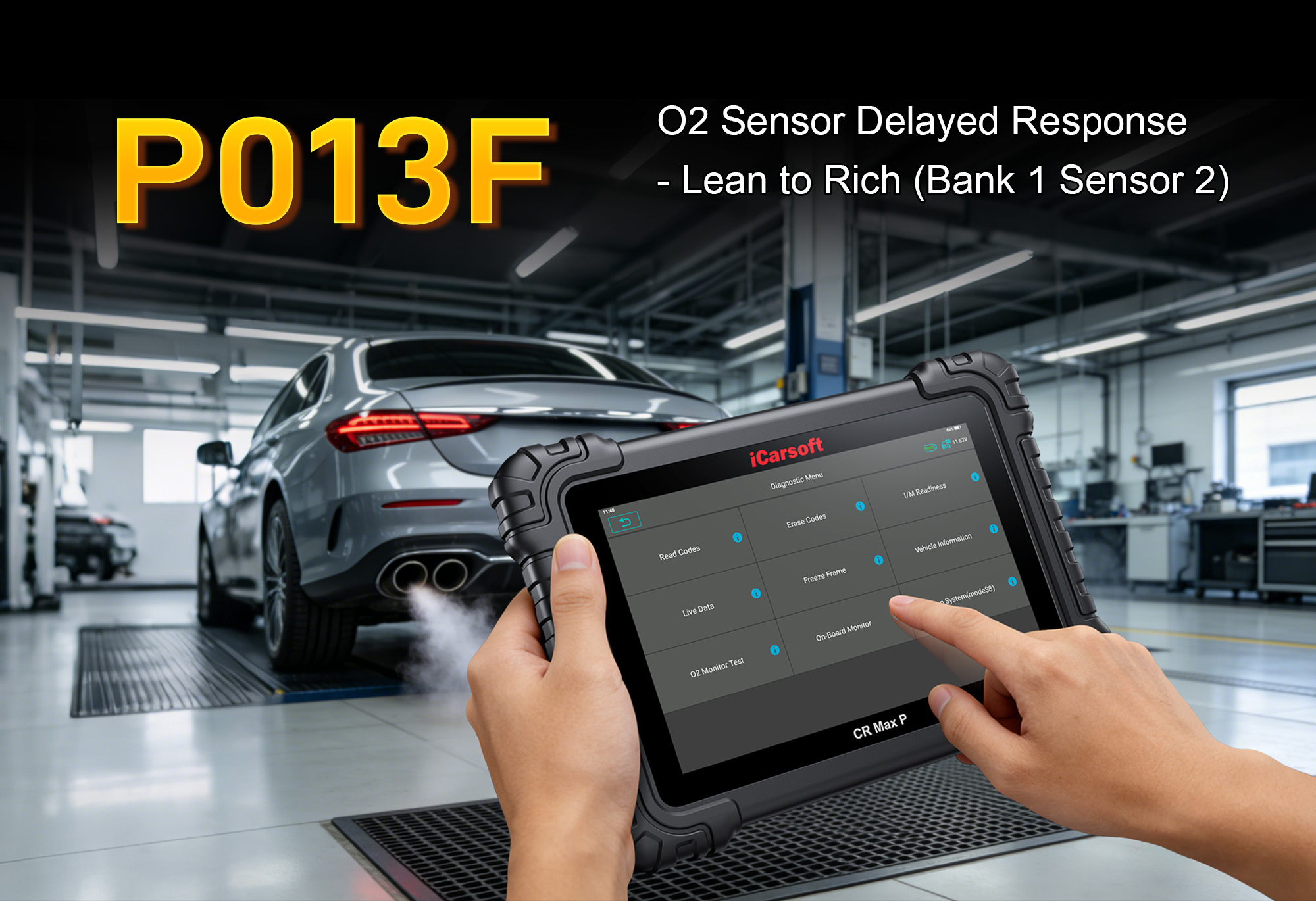
What Is the P013F Fault Code?
The P013F diagnostic trouble code (DTC) is an emissions-focused powertrain code, triggered when the ECM detects the O2 Sensor (typically Bank 1, Sensor 1 or 2, depending on vehicle make/model) fails to transition from a lean to rich signal within the manufacturer’s specified time frame (usually 100–500 milliseconds). Here’s a breakdown of key components:
O2 Sensor: A critical emissions component mounted in the exhaust system (upstream or downstream of the catalytic converter). It monitors exhaust gas oxygen levels, sending voltage signals to the ECM to adjust fuel injection and maintain the ideal 14.7:1 air-fuel ratio.
Delayed Response – Lean to Rich: A “lean” signal (low voltage, ~0.1V) indicates excess oxygen in the exhaust, while a “rich” signal (high voltage, ~0.9V) indicates unburned fuel. P013F occurs when the sensor’s transition between these two states is too slow, meaning the ECM can’t adjust fuel delivery quickly enough for optimal combustion.
Engine & Emissions Impact: When the ECM logs P013F, it defaults to a fixed fuel map, leading to poor fuel efficiency, increased emissions, and potential catalytic converter overheating. Ignoring this code results in failed smog tests, engine carbon buildup, and costly component damage.
Key Symptoms of a P013F O2 Sensor Delayed Response – Lean to Rich Fault
P013F symptoms are tied to impaired O2 sensor performance and worsen during driving conditions that require frequent air-fuel adjustments. If you notice any of these signs alongside a lit check engine light, it’s time to scan your vehicle with the iCarsoft CR Max P:
- Illuminated check engine light (MIL) – the primary and most consistent symptom
- Poor fuel efficiency (10–20% drop in MPG from inefficient combustion)
- Engine hesitation or sluggish acceleration (ECM can’t adjust fuel quickly enough)
- Rough idle or misfiring (unbalanced air-fuel mixture at low RPM)
- Failed emissions tests (excess hydrocarbons or nitrogen oxides)
- Unusual exhaust odor (unburned fuel from rich mixture spikes)
- Reduced engine power (ECM overcompensates for delayed sensor data)
- Dashboard warning messages (e.g., “Emissions System Fault” on modern vehicles)
Common Causes of the P013F Fault Code
P013F is almost always linked to the O2 sensor, exhaust system, or fuel delivery components—it rarely involves major engine mechanical failure, making it a manageable repair for most DIYers with the right diagnostic tool. The iCarsoft CR Max P pinpoints the exact root cause, while generic scanners only label the code without context. These are the most frequent culprits behind P013F, ranked by real-world repair occurrence:
- Aging or contaminated O2 sensor (carbon buildup, oil/gasoline contamination – top cause)
- Exhaust leaks near the O2 sensor (draws in fresh air, skewing readings and delaying responses)
- Clogged fuel injectors (restricted fuel flow slows rich-mixture delivery)
- Low fuel pressure (faulty fuel pump or filter limits fuel supply for rich transitions)
- Corroded or loose O2 sensor wiring/connectors (disrupts signal transmission)
- Catalytic converter degradation (affects exhaust gas composition, confusing the sensor)
- ECM software glitches (incorrectly interpreting sensor signals, extremely rare)
- Aftermarket modifications (e.g., exhaust systems) incompatible with O2 sensor calibration
Why the iCarsoft CR Max P Is the Ultimate Tool for P013F Code Diagnosis & Clearing
Generic OBDII scanners can only read the P013F code and state the “delayed response” issue—they cannot access live sensor data, bi-directional tests, or OE-level emissions diagnostics needed to find the real cause. The iCarsoft CR Max P is engineered with professional-grade features tailored to emissions and engine systems, leveraging its robust hardware and deep multi-system access. Here’s why it stands out for DIYers and mechanics:
Directly connects to the ECM to retrieve manufacturer‑specific P013F details—including real-time O2 sensor voltage, transition time, fuel trim data, and catalytic converter efficiency no generic scanner can see. Supports 58 major vehicle makes.
Analyzes O2 sensor signal patterns, transition timing, and fuel system data to identify exactly what’s causing the delay, eliminating guesswork and costly misdiagnosed parts.
Activates the O2 sensor circuit and tests fuel injector functionality directly from the tool—verifies performance without disassembly. 3x faster than manual testing.
Bluetooth & Wi-Fi let you monitor O2 sensor voltage, fuel trim, and exhaust data in real time on the 10-inch HD touchscreen—catch delays generic tools miss.
Built-in O2S Service (35 makes) calibrates the ECM after sensor replacement. Full OBDII Mode 6 testing verifies repair success instantly.
1GB RAM + 64GB ROM, Android 8.1, Quad-Core 1.3 GHz, 10,000mAh battery (8hr use) — built for shop & fleet diagnostics.
Automatically loads vehicle specs & O2 sensor locations to save time and reduce errors.
One‑click Wi‑Fi updates + 1-year warranty + lifetime technical support for reliable long-term use.
How to Use the iCarsoft CR Max P to Diagnose & Clear P013F
- Plug the iCarsoft CR Max P into your vehicle’s OBDII port (OBDI adaptors available for older models).
- Connect via Bluetooth or use the built‑in 10-inch touchscreen directly.
- Select your make, model, year, engine — Auto VIN Identify auto‑loads system data.
- Navigate to Emissions System > O2S/Oxygen Sensor Control and run a full scan for P013F.
- Review live O2 sensor voltage, transition time, and fuel trim against factory standards.
- Use bi‑directional tests to verify sensor responsiveness and fuel system operation.
- Perform repairs (replace O2 sensor, fix exhaust leaks, service fuel system, repair wiring).
- Use O2S Service to calibrate the ECM and restore accurate air-fuel control.
- Clear P013F fault codes and turn off the check engine light.
- Run a full emissions system reset and re‑scan to confirm permanent resolution.
FAQ: Everything You Need to Know About P013F & the iCarsoft CR Max P
P013F usually affects Bank 1, Sensor 1 (upstream before catalytic converter). The CR Max P shows exact location diagrams & factory transition time limits for your vehicle.
Short emergency trips only. Continued driving ruins catalytic converters ($1,000–$3,000), wastes fuel, and guarantees failed emissions.
No. Basic scanners can’t measure transition time, run sensor tests, or calibrate the ECM. Only the iCarsoft CR Max P provides professional O2 sensor diagnostics.
O2 sensor: $85–$300. Exhaust leak: $30–$200. Fuel system: $40–$300. Wiring: $20–$100. The tool eliminates $300–$600 in dealer fees.
Yes. It displays real-time voltage, calculates lean-to-rich speed, and compares it to manufacturer specs.
Yes. The CR Max P includes automatic O2 sensor relearn — no dealership visit required.
Absolutely. It handles all O2 & emissions codes (P0130–P0149) + 40+ professional service functions.
Yes. Supports OBDI (38Pin/20Pin) with adaptors + lifetime updates for classic models.
Why Ignoring the P013F Code Leads to Costly Emissions & Engine Damage
While P013F appears minor, neglect causes expensive, permanent damage:
- Catalytic Converter Failure – $1,000–$3,000 replacement
- Engine Carbon Buildup – $500+ in cleaning & repairs
- 10–20% higher fuel costs long-term
- Failed emissions tests = fines + registration holds
- Premature failure of downstream O2 sensors
Final Thoughts: Resolve P013F for Good with the iCarsoft CR Max P
The P013F O2 Sensor Delayed Response – Lean to Rich code doesn’t have to be a stressful, expensive problem. With the iCarsoft CR Max P, you have a professional diagnostic tool that gives you the same emissions system access as a dealership technician—at a fraction of the cost. Its real-time transition time monitoring, bi-directional testing, Auto VIN Identify, and 58-make coverage make it perfect for DIYers, while its robust hardware and 40+ service functions make it a must-have for mechanics and fleet managers.
Don’t let a delayed O2 sensor drain your wallet or damage your vehicle’s emissions system. Get the iCarsoft CR Max P today and take control of your vehicle’s diagnostics—resolve P013F accurately, affordably, and for good, and get back on the road with complete confidence in your vehicle’s fuel efficiency and environmental compliance.
Disclaimer: This guide is for informational purposes only. Always consult your vehicle’s service manual or a certified automotive technician before performing emissions or engine repairs. iCarsoft is not responsible for damage from improper tool use or vehicle maintenance.