
P0153 Code: Fix O2 Sensor Circuit Slow Response (Bank 2 Sensor 1) With iCarsoft CR Ultra P
If your check engine light pops on, fuel efficiency plummets, or acceleration feels sluggish with OBD2 code P0153, you’re staring down a critical oxygen sensor fault. P0153 translates to “Oxygen (O2) Sensor Circuit Slow Response (Bank 2 Sensor 1)”—a problem where the upstream O2 sensor on Bank 2 (the cylinder bank without cylinder #1) fails to adjust voltage signals quickly enough to reflect real-time air-fuel ratio changes. Ignore it, and you’ll face sky-high fuel bills, failed emissions tests, and even catalytic converter damage. In this guide, we’ll break down P0153 in plain terms and explain why the iCarsoft CR Ultra P OBD2 Scanner is the ultimate tool to diagnose and clear this fault—perfect for DIYers and professional mechanics alike.
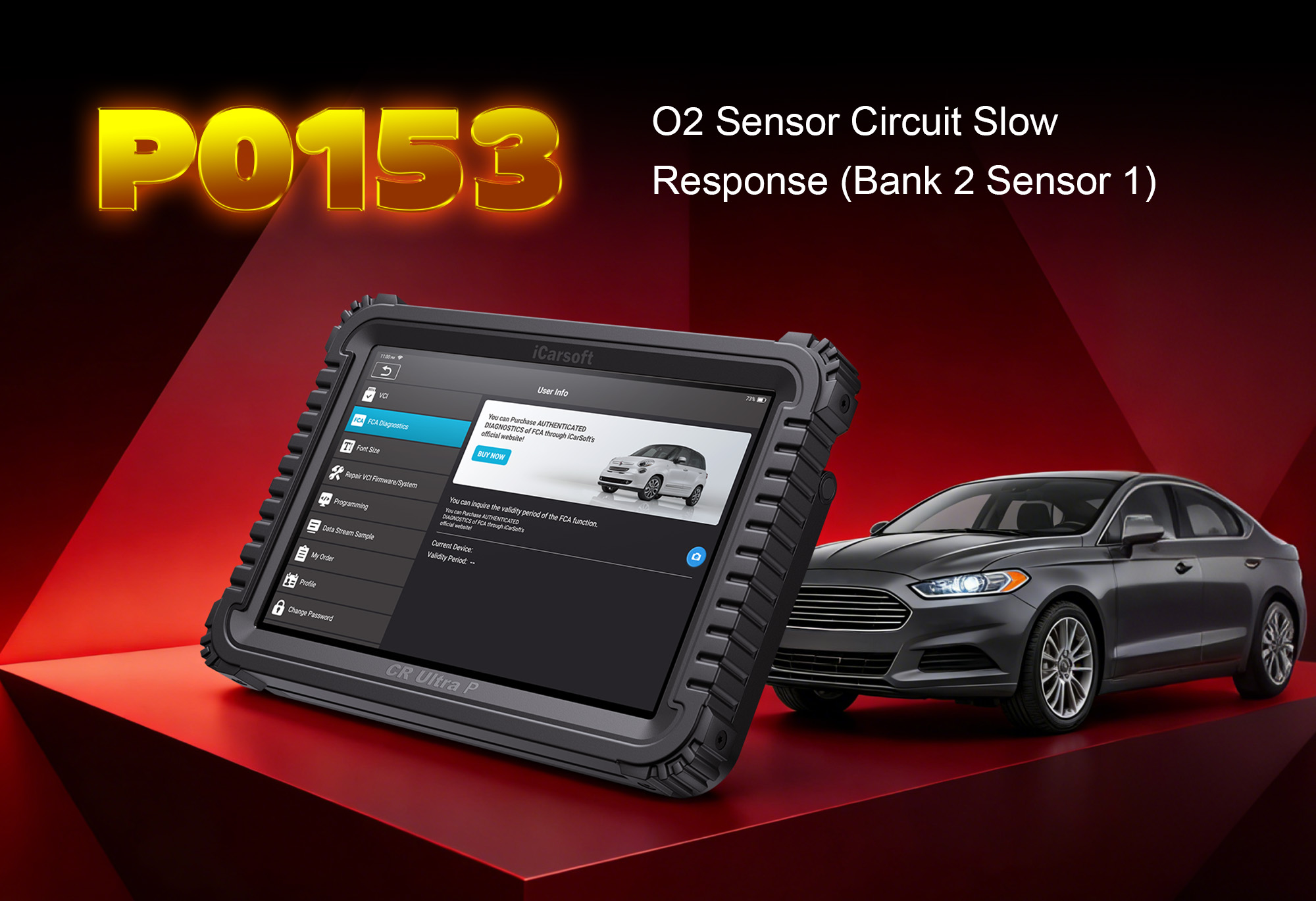
What Exactly Is the P0153 Code?
P0153 is a generic OBD-II diagnostic trouble code (DTC) officially defined as Oxygen Sensor Circuit Slow Response (Bank 2 Sensor 1). Upstream O2 sensors (like Bank 2 Sensor 1) are critical to engine performance: they monitor exhaust gases and send voltage signals (0.1V for lean mixtures, 0.9V for rich mixtures) to the Engine Control Module (ECM). A healthy sensor swings between these values rapidly—typically within 100–200 milliseconds—to help the ECM optimize fuel injection.
P0153 triggers when the ECM detects the Bank 2 Sensor 1 O2 sensor’s response time exceeds the manufacturer’s threshold (often 500+ milliseconds). This delayed signal means the ECM can’t adjust the air-fuel mixture in real time, leading to inefficiency and performance issues. The code is common in popular vehicles like the Ford F-150, Toyota RAV4, Honda Civic, Chevrolet Equinox, Volkswagen Passat, and Hyundai Tucson—especially models with 80,000+ miles or exposure to oil leaks, carbon buildup, or harsh driving conditions.
Common Symptoms of the P0153 Code
P0153 causes noticeable issues that worsen over time—don’t delay repairs:
- Illuminated check engine light (steady, rarely flashing)
- 15–25% drop in fuel economy (wasted fuel from unoptimized mixtures)
- Rough idling or hesitation when accelerating
- Failed state/federal emissions tests (high hydrocarbon and CO levels)
- Reduced engine power (ECM limits performance to protect components)
- Catalytic converter overheating (risk of premature failure)
- Strong fuel odor from the exhaust (unburned fuel)
- Engine misfires at low RPMs (in severe cases)
Top Causes of the P0153 Code
Diagnosing P0153 starts with targeting the O2 sensor and related systems. Here are the most likely culprits (sorted by frequency):
- Faulty Upstream O2 Sensor (Bank 2 Sensor 1): The #1 cause (70% of cases)—worn internal components, carbon buildup, or oil contamination slow signal response.
- Exhaust Leaks: Leaks near the O2 sensor draw in fresh air, skewing readings and delaying signal adjustments.
- Wiring/Connector Damage: Frayed wires, corroded pins, or loose connections between the sensor and ECM disrupt signal transmission.
- Fuel System Issues: Clogged fuel injectors, a faulty fuel pressure regulator, or extreme lean/rich mixtures overload the sensor.
- Engine Oil Contamination: Burning oil (from worn piston rings or valve seals) coats the sensor, blocking its ability to detect air-fuel ratios.
- ECM Malfunction: Rare, but a faulty ECM may misprocess sensor signals or fail to trigger voltage adjustments.
Why the iCarsoft CR Ultra P Is Ideal for P0153 Diagnostics
Basic OBD scanners can read P0153, but they can’t measure response time or test sensor functionality—where the iCarsoft CR Ultra P shines. Built with O2 sensor-specific features, this scanner simplifies P0153 troubleshooting:
Works with 1996+ gasoline vehicles (Europe, Asia, America), including P0153-prone Ford, Toyota, Honda, Chevrolet, and Volkswagen models.
Reads P0153 and related codes (P0133, P0154, P0135) + freeze-frame data (response time, engine RPM, coolant temp) to pinpoint triggers.
Displays live O2 sensor voltage and response time in a 4-in-1 graph—confirms if adjustments exceed 500ms (slow response).
Sends commands to test the sensor’s responsiveness, verifying if it’s faulty without disassembling parts.
Bluetooth 5.0 (30m range) for cable-free work under the hood, plus wired VCI for stable diagnostics in harsh conditions.
Safely erases P0153 post-repair and allows test drive rescans to confirm sensor speed.
Large touchscreen, AutoVIN identification, and 15-language support—no advanced mechanical knowledge needed.
Stays compatible with new vehicle models and updated OBD-II protocols for long-term value.
Step-by-Step P0153 Diagnosis with iCarsoft CR Ultra P
Fix P0153 like a pro with these targeted steps:
Park on level ground, turn off the engine, and let it cool. Visually inspect the Bank 2 Sensor 1 O2 sensor wiring for fraying or corrosion. Plug the CR Ultra P’s VCI dongle into the OBD-II port.
Connect via Bluetooth or use the built-in touchscreen. Select your vehicle make/model and run an Auto Scan to detect P0153 and related sensor codes.
Access Live Data to monitor:
- O2 Sensor Bank 2 Sensor 1 voltage and response time (exceeding 500ms confirms P0153)
- Engine RPM and load (verifies when slow response occurs)
- Short-Term/Long-Term Fuel Trim (STFT/LTFT) (abnormal values indicate fuel system issues)
Use the O2 Sensor Active Test—if the sensor’s voltage swing is delayed, it’s faulty; if responsive, check for exhaust leaks or wiring damage.
Inspect for exhaust leaks (spray soapy water—bubbles indicate leaks), clean/replace corroded connectors, and test wiring continuity.
Replace the faulty sensor or repair wiring/fuel system issues. Perform an ECM reset via the scanner to clear adaptive fuel maps.
Clear P0153 with Quick Erase, take a 30-mile test drive (mix of city/highway), and rescan to ensure no recurrence.
8 FAQs About the P0153 Code & iCarsoft CR Ultra P
P0153 is moderately serious. It won’t disable your vehicle immediately, but prolonged slow sensor response increases fuel costs and risks catalytic converter damage (costing $800–$1,500 to replace). Fix it within 1–2 weeks.
Short trips (under 10 miles) are safe, but avoid long drives or heavy loads. Poor air-fuel optimization reduces efficiency and can overheat the catalytic converter.
Costs range from $60–$180 (DIY O2 sensor replacement) to $300–$700 (dealer labor + parts). The CR Ultra P avoids misdiagnosing expensive catalytic converter repairs.
No—P0153 is a persistent fault caused by a slow/faulty O2 sensor, wiring issue, or exhaust leak. It requires repair before permanent clearance.
Yes—it’s compatible with 99% of 1996+ OBD-II vehicles, including cars, trucks, and SUVs from Ford, Toyota, Honda, Chevrolet, Volkswagen, and more. Check the official compatibility list for your model.
Absolutely—its live data feature displays exact response time (in milliseconds), confirming if the sensor is slow (exceeding 500ms) or functioning normally.
Related codes include P0133 (O2 Sensor Slow Response Bank 1 Sensor 1), P0154 (O2 Sensor No Activity Bank 2 Sensor 1), and P0135 (O2 Sensor Heater Circuit Malfunction).
No—the scanner’s intuitive touchscreen, AutoVIN, and step-by-step prompts make it beginner-friendly. Multilingual support and a built-in DTC library ensure confidence in diagnosing P0153.
Final Thoughts: Don’t Let P0153 Waste Fuel & Damage Your Vehicle
The P0153 code is a clear warning of O2 sensor issues that hurt your wallet and vehicle health. The iCarsoft CR Ultra P simplifies P0153 diagnosis with professional-grade features—from real-time response monitoring to active sensor tests—saving you time and money on dealer fees. Whether you’re a DIY enthusiast, daily commuter, or mechanic, this scanner is a long-term investment that protects your engine and bottom line.
Ready to fix P0153, restore fuel efficiency, and pass emissions tests? Click below to get the iCarsoft CR Ultra P today!
Have questions about P0153 or the iCarsoft CR Ultra P? Drop a comment below—we’re here to help!
Disclaimer: This guide is for informational purposes only. Always consult your vehicle’s owner’s manual or a certified mechanic before major repairs. iCarsoft is not responsible for damage from improper tool use.