
P1611 Error Code: What It Means, Causes, and Fixes (iCarsoft CR MAX Guide)
Imagine turning your car key (or pressing the start button) only to have the engine crank but not start—all while a security light flashes on the dashboard. Chances are, you’re dealing with OBD-II code P1611, a critical error that disrupts communication between your engine’s brain and its security system. Most common in Toyota models, this code demands swift diagnosis—and the iCarsoft CR MAX is the tool to make it simple.
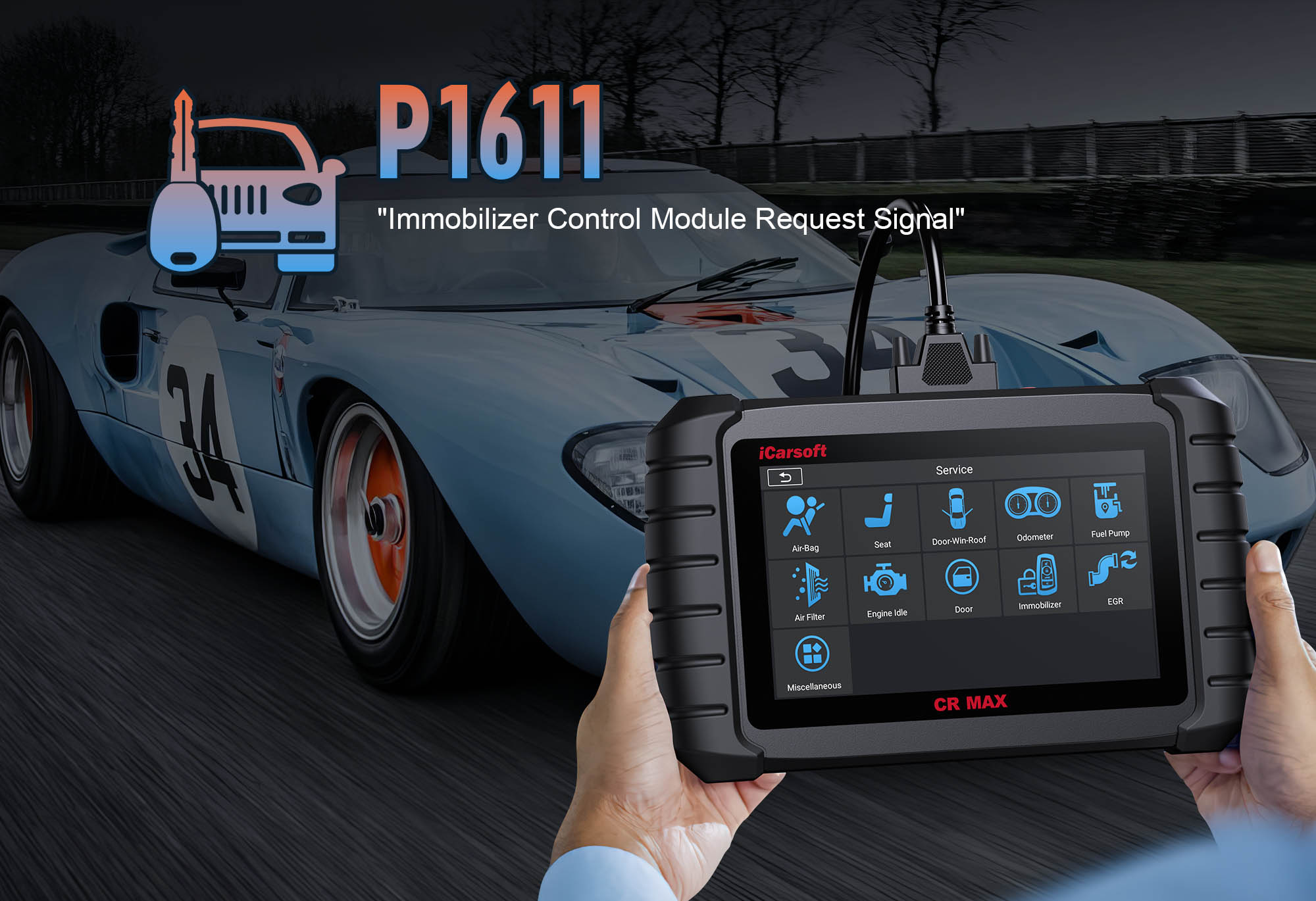
What Is the P1611 Code?
P1611 is a manufacturer-specific (or semi-generic) OBD-II diagnostic trouble code defined as "Engine Control Module (ECM) – Immobilizer Communication Failure". It triggers when the ECM (the vehicle’s "engine computer") cannot send or receive signals from the immobilizer system—the security feature that prevents unauthorized engine starts (e.g., with a stolen key).
Key Context for Toyota Owners: P1611 is most prevalent in Toyota/Lexus models (e.g., Camry, Corolla, RAV4, Prius) manufactured between 2000–2020. Toyota’s immobilizer system (called "Toyota Immobilizer 2" or "Smart Key System") relies on a chip in the key fob, an antenna ring around the ignition, and a dedicated immobilizer control module—all of which must communicate with the ECM to start the engine. A break in this chain = P1611.
Why this matters: Without a working ECM-immobilizer connection, the immobilizer "locks" the engine, even if you have the correct key. This is a security feature—but when communication fails accidentally, it leaves you stranded.
Symptoms That Shouldn’t Be Ignored
P1611 symptoms are impossible to miss—they directly impact your ability to start and drive your vehicle:
The ECM triggers the check engine light as soon as it detects a communication breakdown. The light will stay steady (not flashing) since P1611 is a "security/communication" error, not an engine performance fault.
A dedicated "Security" or "Immobilizer" light (often shaped like a car with a key, or a flashing key icon) will blink rapidly (1–2 times per second) when P1611 is active. This is the immobilizer’s way of signaling a communication failure.
The most frustrating symptom: The engine may crank strongly but never fire up. In mild cases, it might start occasionally (e.g., after 5–10 tries) but stall shortly after—this happens when communication is intermittent.
In Toyota’s Smart Key systems, P1611 may cause the key fob to stop working (e.g., can’t unlock doors remotely, or the "push-to-start" button flashes red). This is because the fob’s chip can’t sync with the immobilizer.
Likely Causes at a Glance
P1611 stems from issues that break the ECM-immobilizer communication chain. Below are the most common culprits, ordered by how often they’re reported (especially in Toyotas):
The immobilizer module (often mounted under the dashboard or near the steering column) acts as a middleman between the key fob and ECM. Internal component failure (from water damage, vibration, or age) prevents it from relaying signals—this is the top cause of P1611 in older Toyotas.
Wires linking the ECM, immobilizer module, and ignition antenna ring are prone to damage. Common issues: frayed wires (from rodent chewing or dashboard removal), corroded connectors (from moisture leaks), or loose terminals (from vibration). Any of these disrupt signal flow.
The immobilizer system has a dedicated fuse (located in the engine bay or interior fuse box). A blown fuse cuts power to the module or its wiring, stopping communication with the ECM. This is an easy fix—but often overlooked.
Internal ECM faults (e.g., damaged circuit boards, failed communication chips) rarely cause P1611—but they’re possible. The ECM may lose its ability to "talk" to the immobilizer, even if the module and wiring are fine. This is only likely after ruling out all other causes.
Loose plugs at the ECM (under the hood) or immobilizer module (under the dashboard) can break communication. This often happens after service work (e.g., battery replacement, dashboard repairs) where connectors are accidentally not fully seated.
Troubleshooting Steps Simplified (with iCarsoft CR MAX)
Fixing P1611 requires pinpointing where the communication chain broke—and the CR MAX eliminates guesswork. Follow this step-by-step process:
-
1. Scan for P1611 and Related Codes
- Connect the CR MAX to your vehicle’s OBD-II port (under the dashboard), power it on, and select "Toyota/Lexus" (or use AutoVIN Recognition to auto-identify your model).
- Navigate to Immobilizer System > Fault Codes > Read Codes (not just the Engine module!) to confirm P1611. Check for related codes like P1610 ("Immobilizer Communication Error") or P1612 ("Immobilizer Authentication Failure")—these add context.
- Review freeze-frame data (if available) to see when the code triggered (e.g., "After Battery Replacement" or "During Key Fob Battery Change")—this hints at the cause.
-
2. Check the Immobilizer Fuse
- Use the CR MAX’s Component Location feature to find the immobilizer fuse (Toyota labels it "IMMO" or "Immobilizer" in the fuse box diagram).
- Visually inspect the fuse—if the metal strip inside is broken, replace it with a new fuse of the same amperage (typically 7.5A or 10A, per Toyota specs).
- After replacing, use the CR MAX to clear codes and try starting the engine—if it starts, the fuse was the issue.
-
3. Inspect Immobilizer Module, Wiring, and Antenna
- Locate the immobilizer module (CR MAX’s Wiring Diagrams show exact placement—usually under the driver’s side dashboard, near the ignition switch).
-
Inspect for:
- Water damage (stained or moldy module—common if the cabin has leaks).
- Corroded connectors (spray with electrical contact cleaner to remove rust).
- Frayed wires (check the harness leading to the ignition antenna ring—rodents often chew this).
- For the ignition antenna ring (around the key slot), ensure it’s not cracked or disconnected—this ring reads the key fob’s chip signal.
-
4. Test Circuit Continuity & Voltage with CR MAX
-
Use the CR MAX’s built-in Multimeter to verify the immobilizer circuit:
- Continuity Test: Check wires between the immobilizer module and ECM—no "beep" means a broken wire (repair or replace).
- Voltage Test: Measure power at the immobilizer module (should read 12V from the battery). Low or no voltage confirms a fuse or power supply issue.
- Use the CR MAX’s Live Data (under Immobilizer System) to monitor "Key Authentication Status"—if it shows "Failed" with a valid key, the module or antenna is faulty.
-
Use the CR MAX’s built-in Multimeter to verify the immobilizer circuit:
-
5. Replace Defective Components
- Immobilizer Module: If tests confirm a faulty module, replace it with an OEM part (aftermarket modules often require dealer reprogramming). For Toyotas, ensure the new module matches your vehicle’s VIN—this is a security-critical part.
- Wiring/Connectors: Repair frayed wires with heat-shrink tubing; replace corroded connectors with OEM replacements.
- ECM: If all other parts check out, consult a Toyota specialist—ECM replacement requires programming to match your immobilizer and key fob (DIY is not recommended).
-
6. Verify Repairs with CR MAX
- Use the CR MAX to Clear Fault Codes from both the Immobilizer and Engine systems.
- Test the key fob (lock/unlock doors) and start the engine—if it starts smoothly and the security light turns off, the repair worked.
- Test drive for 10–15 miles, then re-scan with the CR MAX—ensure P1611 does not return.
Why Pro-Level Tools Matter – Spotlight on CR MAX
How iCarsoft CR MAX Solves P1611 Faster Than Basic Scanners
Basic scanners only read engine codes—they can’t access the immobilizer system. The CR MAX lets you scan, clear, and monitor the immobilizer directly, which is mandatory for diagnosing P1611.
Includes Toyota/Lexus immobilizer wiring diagrams, fuse locations, and module positions—no more searching for "Toyota immobilizer module location" online.
After replacing the immobilizer module, use the CR MAX to program your key fob—dealer programming costs $100–$200, but this feature lets you do it yourself.
Monitor "Key Authentication Status," "Module Voltage," and "ECM Communication" in real time—see exactly where the signal is breaking (e.g., "Key Authenticated, but Module Not Communicating").
No need for a separate multimeter—test wiring and voltage directly from the CR MAX, saving time and tool clutter.
Risks of Ignoring the Code
Ignoring P1611 isn’t just inconvenient—it can leave you stranded and increase repair costs:
What starts as intermittent starting will eventually become a total no-start. You may be stuck at home, work, or on the road—requiring a tow (costing $100–$300).
While P1611 usually locks the engine, a faulty immobilizer system could also fail to lock it—making your vehicle vulnerable to theft.
Imagine the immobilizer failing during an emergency (e.g., rushing to the hospital)—a stalled engine could put you or others at risk.
A simple blown fuse ($5 fix) or corroded wire ($20 repair) can escalate to ECM replacement ($800–$1,500) if left unaddressed—moisture or vibration will damage other components over time.
How to Prevent P1611 Errors in the Future
Avoid P1611 with these simple maintenance habits—many use the CR MAX to stay proactive:
-
1. Inspect Immobilizer Components Annually
- Check the immobilizer fuse during oil changes—replace it if it’s worn (even if not blown, old fuses are prone to failure).
- Inspect the ignition antenna ring for cracks—clean it with a dry cloth to remove dust or debris.
-
2. Protect Against Water Damage
- Fix cabin leaks (e.g., sunroof drains, windshield seals) immediately—water is the #1 cause of immobilizer module failure in Toyotas.
- Avoid spilling liquids (coffee, soda) on the dashboard—this can seep into the immobilizer module below.
-
3. Maintain Clean, Tight Connections
- After battery replacement or dashboard work, ensure all ECM and immobilizer connectors are fully seated—use dielectric grease on terminals to prevent corrosion.
-
4. Scan Proactively with CR MAX
- Run a full system scan (Engine + Immobilizer) every 3 months—catch pending P1611-related issues (e.g., "Intermittent Module Communication") before they cause a no-start.
-
5. Replace Key Fob Batteries Promptly
- A weak key fob battery can cause intermittent authentication failures, which may trigger P1611 over time. Replace batteries every 1–2 years (use CR2032 for most Toyota fobs).
When It’s Time to Call in Reinforcements
DIY repairs work for most P1611 cases (fuses, wiring, module replacement), but consult a Toyota specialist if:
- You’ve replaced the immobilizer module and key fob, but the CR MAX still shows "Key Not Authenticated"—this requires dealer-level programming to sync the module with the vehicle’s VIN.
- The CR MAX indicates an ECM fault (e.g., "ECM Communication Failed")—ECM repair/replacement needs specialized tools to reflash Toyota’s proprietary software.
- P1611 returns after DIY fixes—this may mean hidden damage (e.g., water-logged wiring harness) that’s hard to spot without professional diagnostics.
- You’re uncomfortable working with security-critical systems—mistakes (e.g., incorrect module programming) can lock you out of the vehicle permanently.
FAQ: Common Questions About P1611
- Blown fuse: $5–$20 (DIY).
- Wiring repair: $20–$100 (DIY with CR MAX; $150–$300 at a shop).
- Immobilizer module replacement: $150–$400 (OEM part + DIY; $300–$600 at a shop).
- ECM repair/replacement: $800–$1,500 (professional only).
- Dealer key programming: $100–$200 (avoidable with CR MAX’s Key Registration feature).
Summary Table: P1611 Diagnosis & Repair Steps
| Step | Action with iCarsoft CR MAX | Common Fix |
|---|---|---|
| 1 | Scan Immobilizer + Engine systems; confirm P1611 | Identify communication failure source |
| 2 | Locate immobilizer fuse via Component Location; inspect | Replace blown fuse |
| 3 | Trace wiring with diagrams; test continuity/voltage | Repair corroded wires or loose connectors |
| 4 | Monitor live immobilizer data; check key authentication | Replace faulty immobilizer module |
| 5 | Register key fob (if module replaced); clear codes + re-scan | Confirm ECM-immobilizer communication is restored |
Final Thoughts
P1611 is more than a "check engine light"—it’s a security and reliability issue that can leave you stranded. But with the right knowledge and tools, it’s a fixable problem. The key is to diagnose where the ECM-immobilizer communication is breaking (fuse, wiring, module) and address it promptly.
The iCarsoft CR MAX is indispensable for this task: it accesses the immobilizer system (unlike basic scanners), provides Toyota-specific diagrams, and even programs key fobs after module replacement. For DIYers and mechanics alike, it turns a frustrating no-start into a manageable repair.
Don’t let P1611 keep you off the road. With proactive maintenance, the CR MAX, and this guide, you’ll resolve the issue quickly—and keep your vehicle’s security and engine running smoothly.