
Fix P2031: Exhaust Gas Temperature Sensor Circuit Bank 1 Sensor 1 Range/Performance – Trust iCarsoft CR Eagle
If your check engine light illuminates and you notice reduced engine power, rough idling, or poor fuel efficiency, your diagnostic tool may retrieve P2031. This trouble code points to a critical issue with your vehicle’s Exhaust Gas Temperature (EGT) Sensor Circuit Bank 1 Sensor 1—specifically a “Range/Performance” malfunction. The EGT sensor monitors exhaust gas temperature to help the Engine Control Unit (ECU) regulate emissions systems (e.g., diesel particulate filters) and engine performance. Ignoring P2031 can lead to increased emissions, component overheating, and costly repairs. In this guide, we’ll break down P2031, its causes, and how the iCarsoft CR Eagle—an OE-level diagnostic tool—helps you resolve it efficiently.
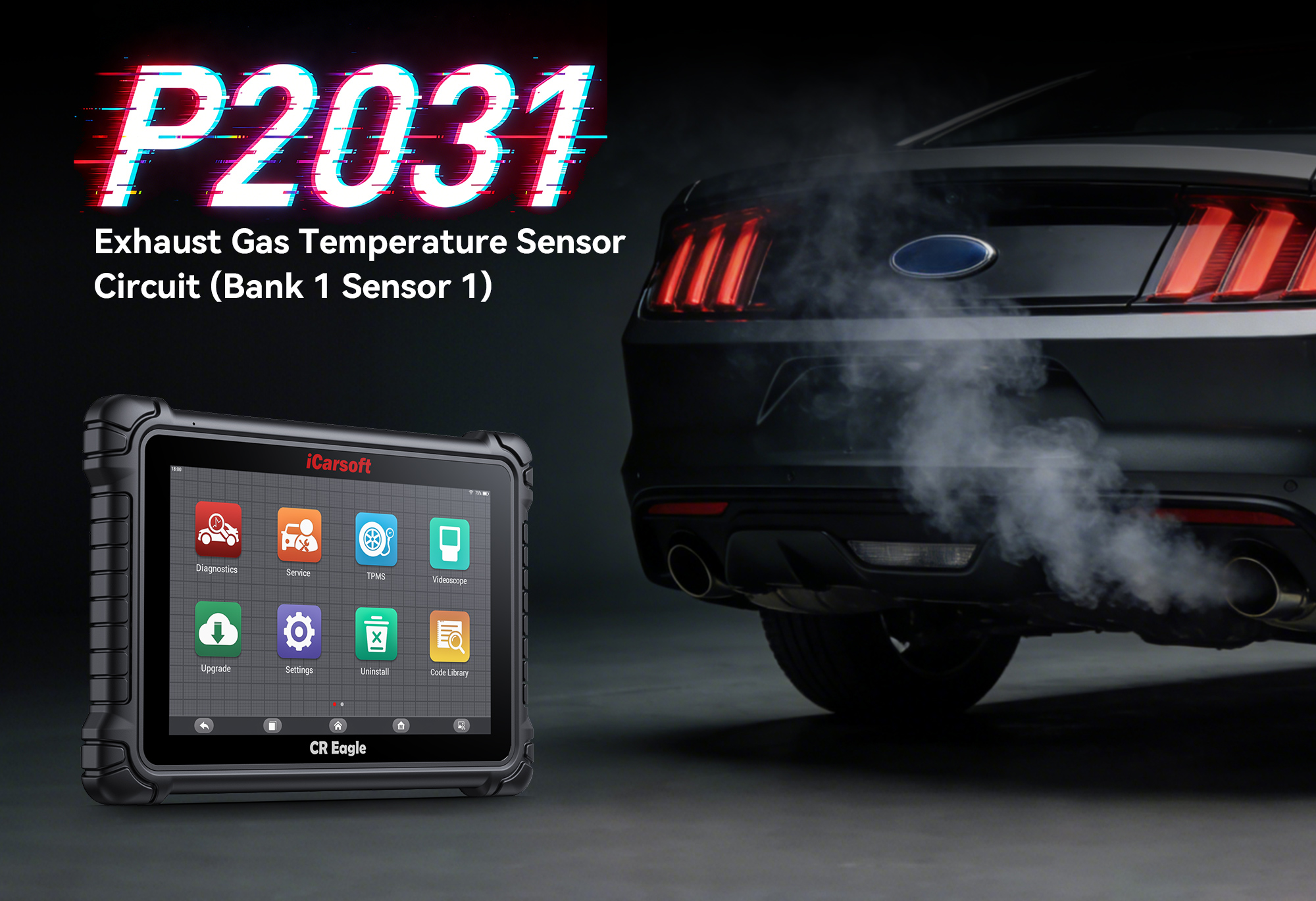
What Exactly Is Fault Code P2031?
P2031 is a generic OBD-II trouble code defined as “Exhaust Gas Temperature (EGT) Sensor Circuit Bank 1 Sensor 1 Range/Performance”. Key details to understand:
- Bank 1 refers to the cylinder bank containing cylinder #1; Sensor 1 is the primary EGT sensor located closest to the engine (before emissions components like catalytic converters or DPFs).
- The EGT sensor sends voltage signals to the ECU that correspond to exhaust gas temperature—higher temperatures trigger specific voltage changes.
- A “range/performance” issue means the ECU detects a signal from the sensor that falls outside the normal operating range (too high, too low, or unresponsive) for a sustained period.
- P2031 applies to 1996+ OBD-II compliant vehicles (gasoline and diesel), including popular makes like Ford, Toyota, Honda, BMW, Mercedes-Benz, VW, and diesel models from Cummins or Duramax.
Why Does P2031 Happen? Common Causes
Internal electrical failure, thermal degradation, or sensor element damage leads to inaccurate signal transmission.
Frayed, shorted, or corroded wires, or loose/dirty connectors between the sensor and ECU—exacerbated by high exhaust heat.
Soot, oil, or carbon buildup on the sensor’s sensing element blocks temperature detection.
Leaks near the sensor alter exhaust gas flow, leading to false temperature readings.
Cracked manifolds or loose flanges disrupt exhaust gas path, affecting sensor data.
Rarely, a faulty ECU misinterprets signals; engine misfires/rich fuel mixtures cause high exhaust temps damaging the sensor.
Symptoms of P2031
P2031 often presents noticeable symptoms, including:
- Illuminated check engine light (primary indicator).
- Reduced engine power or “limp mode” (to protect emissions components).
- Poor fuel efficiency due to incorrect ECU calibration.
- Rough idling or engine misfires (especially in diesel models).
- Increased exhaust emissions (failed emissions tests).
- Overheating of exhaust components (risk of damage to catalytic converters/DPFs).
- Hesitation during acceleration.
Why the iCarsoft CR Eagle Is Perfect for P2031
Basic scanners only read P2031, but the iCarsoft CR Eagle offers advanced features that simplify diagnosing EGT sensor issues. Here’s why it stands out:
Dives deep into Bank 1 Sensor 1, wiring, connectors, and ECU communication to pinpoint the range/performance issue.
Views real-time EGT sensor voltage and temperature readings—confirms if the signal is outside the normal range, even during driving.
Sends commands to test the EGT sensor circuit—verifies if the sensor responds to temperature changes without disassembly.
Works with 58 major vehicle makes, including gasoline/diesel models and OBDI vehicles (with included adaptors like Benz38Pin and BMW20Pin).
Features a 10.1-inch touchscreen, 4GB RAM + 128GB ROM, and dual-band Wi-Fi/Bluetooth for smooth wireless diagnostics.
Reconfigures the ECU after sensor replacement to restore emissions and performance calibration.
Built-in TPMS programming (with 4 sensors) and a videoscope to inspect the EGT sensor for contamination and exhaust leaks.
Stays compatible with new EGT sensor designs and diesel emissions systems.
How to Diagnose & Fix P2031 with the iCarsoft CR Eagle (Step-by-Step)
Plug the CR Eagle’s OBD-II cable into your vehicle’s port (under the dashboard). Use included OBDI adaptors for older models.
The tool automatically retrieves your vehicle’s make, model, VIN, and engine configuration—no manual entry needed.
Select “Full System Scan” or “Engine/Emissions System Scan” to pull up P2031 and related codes (e.g., P2032 for high sensor voltage).
Navigate to “Live Data” to monitor EGT sensor (Bank 1 Sensor 1) voltage/temperature. A reading outside the vehicle’s normal range confirms P2031.
Use the “Active Test” function to test the sensor circuit. No response or erratic signals indicate a faulty sensor or wiring issue.
Use the CR Eagle’s videoscope to check the EGT sensor for contamination and exhaust pipes for leaks. Inspect wiring for heat damage.
Replace the faulty EGT sensor, repair/replace damaged wiring, clean connectors, or fix exhaust leaks.
Use the CR Eagle to erase P2031, take a test drive (including highway speeds), and re-scan to ensure the code doesn’t return.
FAQs: Your P2031 Questions Answered
You can drive short distances, but reduced power and emissions component damage risks make prompt diagnosis with the CR Eagle critical. Avoid heavy loads or long trips.
Yes! It supports 58 major makes, including both gasoline and diesel models (e.g., Ford Power Stroke, Chevy Duramax) with EGT sensors. OBDI models work with included adaptors.
No! Its 10.1-inch touchscreen, AutoVIN function, and clear prompts make it user-friendly for DIYers. Lifetime technical support is available if you need help.
Absolutely. Live data shows if signals normalize after fixing leaks (exhaust issue) or remain abnormal (faulty sensor). Bi-directional tests confirm sensor functionality.
The CR Eagle’s videoscope helps you decide—cleaning works for light soot buildup; replacement is needed for damaged sensor elements or electrical failure.
Yes. Basic scanners only read the code, but the CR Eagle provides live EGT data and circuit tests—avoiding unnecessary sensor replacements.
Update every 3–6 months via free Wi-Fi updates to ensure compatibility with new EGT sensor designs and emissions system diagnostics.
Yes! It includes an OBD-II cable, 4 OBDI adaptors, 4 TPMS sensors, a videoscope, and a carrying case—no extra tools required for P2031 diagnosis.
Final Thoughts: Don’t Let P2031 Damage Your Emissions System
P2031 is a warning that your EGT Sensor (Bank 1 Sensor 1) is malfunctioning, compromising engine performance and emissions compliance. The iCarsoft CR Eagle isn’t just a tool for fixing P2031—it’s a comprehensive diagnostic solution that handles over 40 high-level service functions, making it a long-term investment for all your vehicle maintenance needs. Whether you’re a DIY enthusiast or a professional, the CR Eagle gives you the power to diagnose and fix P2031 right from your garage.
Invest in the iCarsoft CR Eagle today to tackle P2031 and hundreds of other codes—keep your vehicle running cleanly and efficiently.