
Understanding OBD-II Code P0406: "EGR Sensor A Circuit High" — Diagnose & Resolve with CR MAX
If your diagnostic scan reveals the P0406 code, you’re facing an issue with your vehicle’s Exhaust Gas Recirculation (EGR) system—specifically a "high voltage" fault in the EGR position sensor circuit. This code can cause hidden performance issues and emissions problems, but diagnosing it doesn’t have to be overwhelming. In this guide, we’ll break down what P0406 means, its common causes and symptoms, and how the iCarsoft CR MAX diagnostic tool streamlines accurate diagnosis and repairs.
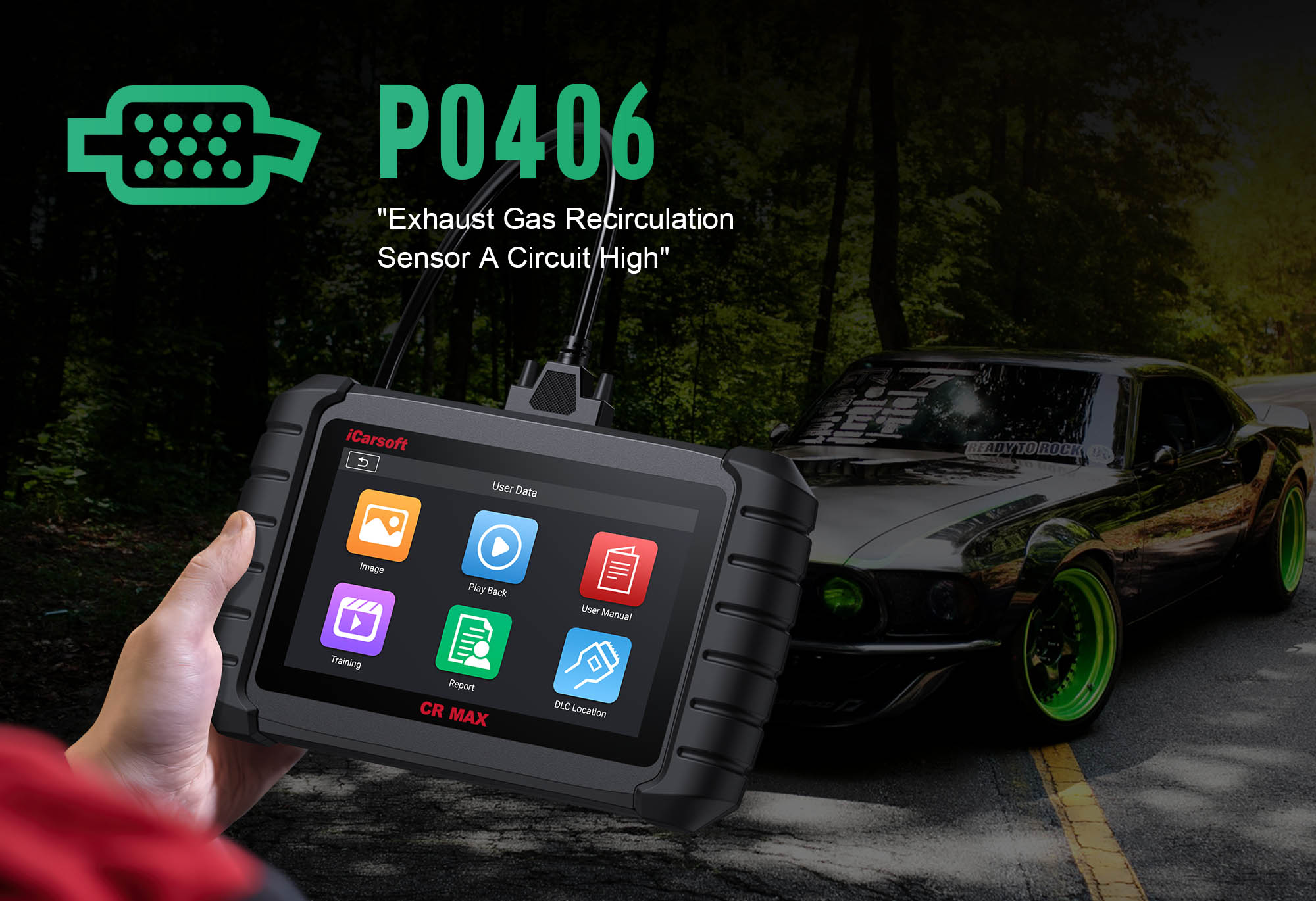
What Does OBD-II Code P0406 Mean?
DTC P0406—officially labeled "Exhaust Gas Recirculation (EGR) Sensor A Circuit High"—triggers when the Engine Control Module (ECM) detects voltage from the EGR position sensor that exceeds the manufacturer’s normal range (typically 0.5V–4.5V for most vehicles). When this high voltage persists, the ECM illuminates the Check Engine Light to alert you to the fault.
To understand why this matters, let’s recap the EGR system’s role:
- The EGR valve reduces harmful nitrogen oxide (NOx) emissions by recirculating a small amount of exhaust gas back into the combustion chamber. This lowers combustion temperatures, which limits NOx production.
- The EGR position sensor (often integrated into the EGR valve) monitors the valve’s opening/closing position and sends voltage signals to the ECM. The ECM uses this data to adjust EGR flow—ensuring optimal emissions control and engine performance.
A "high circuit" fault (P0406) tells you the sensor is sending too much voltage—meaning the ECM can’t trust the data to control the EGR valve properly.
Common Causes of the P0406 Code
P0406 stems from issues that force the EGR position sensor to send abnormal high voltage. Below are the most frequent culprits, ordered by likelihood:
Internal electrical failure in the sensor (e.g., shorted windings) causes it to output voltage above the normal range— the top cause of P0406.
Carbon buildup clogs the valve, preventing it from opening/closing properly. The sensor misreads the stuck position, sending high voltage.
Damaged wires, corroded connectors, or a short to the 5V reference circuit force excess voltage into the sensor signal wire.
Outdated ECM/PCM firmware misinterprets normal sensor voltage as "high"—fixed with a manufacturer software update.
Recognizing the Symptoms of P0406
P0406 symptoms are often subtle, but ignoring them leads to worse performance and emissions issues. Watch for these signs:
The most obvious indicator— the light stays on until the code is cleared (and the issue fixed).
Hesitation during acceleration, especially at highway speeds; engine feels "sluggish" when passing.
Incorrect EGR flow disrupts combustion efficiency, lowering MPG by 8–12%.
Without proper EGR flow, combustion temperatures rise—causing pre-ignition (pinging) under load (e.g., climbing hills).
A fully stuck EGR valve can flood the combustion chamber with exhaust gas, leading to stalling at idle or low speeds.
High NOx levels (from faulty EGR operation) will cause your vehicle to fail state emissions tests.
How to Diagnose P0406 — 4 Key Steps
Diagnosing P0406 requires a structured approach—skip steps, and you’ll replace good parts unnecessarily. Use the iCarsoft CR MAX to simplify each phase:
-
Read the Code & Analyze Freeze-Frame Data
- Plug the CR MAX into your vehicle’s OBD-II port, power it on, and select your make/model/year (use Auto VIN Recognition for accuracy—no manual entry errors).
- Navigate to Engine Control Module > Fault Codes > Read Codes to confirm P0406.
- Tap Freeze-Frame Data to see when the code triggered (e.g., "65 mph, 2,500 RPM, 80°F engine temp")—this reveals conditions that worsen the fault.
-
Inspect Wiring & Connector Integrity
Circuit issues cause 25% of P0406 cases—here’s how to check:
- Locate the EGR position sensor and wiring harness using the CR MAX’s Component Location guide (varies by vehicle—often near the intake manifold).
-
Visually inspect for:
- Frayed or cracked wires (common near hot engine components).
- Corroded or bent connector pins (clean with electrical contact cleaner if needed).
- Loose terminals (wiggle the connector—if it moves easily, it’s not secured).
- Use the CR MAX’s Multimeter > Continuity Test to check for shorts: Connect probes to the sensor’s signal wire and 5V reference wire—continuity = short circuit (repair the wire).
-
Physically Check the EGR Valve & Sensor
Carbon buildup and stuck valves are easy to fix—don’t overlook them:
- Remove the EGR valve (follow the CR MAX’s disassembly guide for your vehicle).
- Inspect for carbon buildup: Use a wire brush or specialized EGR cleaner to remove deposits from the valve seat and pintle.
- Test the valve manually: Move the pintle (the small metal rod inside) back and forth—if it’s stuck, clean further or replace the valve.
- Inspect the sensor (often on top of the valve) for physical damage (e.g., cracked housing)—damage means replacement.
-
Test Live Data & Sensor Voltage
The CR MAX’s live data feature confirms if the sensor is truly sending high voltage:
-
Go to Engine > Live Data > EGR System and select:
- EGR Position Sensor Voltage (should be 0.5V–4.5V)
- EGR Valve Position (%)
- Engine RPM
-
Start the engine and monitor data:
- If voltage stays above 4.5V (or manufacturer’s spec), the sensor is faulty.
- If voltage spikes when the engine accelerates, the issue is a loose wire or short.
-
Go to Engine > Live Data > EGR System and select:
Why CR MAX Is a Powerful Tool for P0406 Diagnosis
Basic scanners only tell you "P0406"—they can’t distinguish between a faulty sensor, stuck valve, or wiring issue. The iCarsoft CR MAX solves this with EGR-specific features that save time and money:
Manually command the EGR valve to open/close via the CR MAX—monitor if the position sensor responds correctly. If the valve moves but voltage stays high, the sensor is faulty.
View real-time EGR sensor voltage, valve position, and flow rate—critical for spotting high-voltage spikes that basic tools miss.
Supports 10,000+ models across 90+ brands (Ford, Toyota, BMW, GM)—works with virtually any EGR system.
Automatically identifies your vehicle’s specs, so you skip manual make/model selection and start diagnosing immediately.
Large touchscreen and step-by-step prompts make "how to fix P0406" simple—even for first-time DIYers.
Keep the CR MAX current with new vehicle models and EGR system tech—no subscription fees.
Example Workflow: Diagnosing P0406 With CR MAX
Follow this step-by-step process to go from "code detected" to "root cause found" in minutes:
- Connect the CR MAX to your vehicle’s OBD-II port (under the dashboard) and power it on.
- Select Auto VIN—the CR MAX scans your vehicle’s VIN and loads the correct EGR system parameters.
- Navigate to Engine > Live Data > EGR System: Notice EGR sensor voltage is 5.2V (above the 4.5V max spec)—confirm P0406 is active.
-
Run a Bi-Directional EGR Test (under Special Functions > EGR Tests):
- Command the EGR valve to open to 50%—the CR MAX shows the valve moves, but sensor voltage stays at 5.2V.
- This confirms the valve works, but the sensor is faulty (not a wiring issue).
- Use the CR MAX’s Component Location guide to find the EGR sensor—remove and replace it with an OEM-compatible part.
- Reconnect the CR MAX, clear the P0406 code (under Fault Codes > Clear Codes), and monitor live data: Voltage now stays between 0.8V–4.2V—fix successful.
Closing Thoughts: Keep It Simple with CR MAX
The P0406 code—"EGR Sensor A Circuit High"—may sound technical, but it doesn’t have to be a headache. With clarity on its causes (faulty sensor, stuck valve, wiring) and symptoms (poor MPG, pinging), you’re halfway to a fix.
The iCarsoft CR MAX turns the remaining half into a straightforward process: Its bi-directional control isolates faulty parts, live data confirms high voltage, and vehicle-specific guides eliminate guesswork. Whether you’re a DIY mechanic or a professional shop, the CR MAX is the tool you need to resolve P0406 quickly and confidently.
Don’t let a confusing EGR fault slow you down. With the CR MAX, you’ll go from "what is P0406?" to "fixed!" in no time—restoring your vehicle’s performance and keeping emissions in check.